5.5 Logical Operators
Key terms: logical operator, logical OR, pipe symbol, logical AND, negation (not) operator, short-circuit evaluation
5.5.1 Logical OR
The decision logic in the ComeOutRoll program of the previous section translated directly
into English would read:
If the sum is 7 then you win, otherwise if the sum is 11 then you win, otherwise if the sum is 2 then you lose, otherwise if the sum is 3 then you lose, otherwise if the sum is 12 then you lose, otherwise the game continues.
But in ordinary speech this would be expressed more naturally as:
If the sum is 7 or 11 then you win, otherwise if the sum is 2, 3, or 12 then you lose, otherwise the game continues.
Java provides logical operators analogous to the English words or and and. The logical
OR operator, written ||, corresponds to disjunction in formal logic: it evaluates to true if
at least one of its operands is true. The | character is called the pipe symbol.
Listing 5.5.1 shows the most succinct version of ComeOutRoll using logical OR to combine the
winning conditions into a single expression and likewise for the losing conditions.
Listing 5.5.1 - ComeOutRoll.java
Be careful to type the pipe symbol twice when writing logical OR. A single pipe is also a valid Java
operator, one of the bitwise operators, which are not covered in this book. Although x | y and
x || y are both syntactically valid when x and y are Boolean expressions, they have different
meanings.
5.5.2 Logical AND
Suppose that a PASS/FAIL grade depends on three exam scores. There are two possible ways to pass:
- The average of the two highest scores (
avg2) is at least 90. - The average of all three scores (
avg3) is at least 80 and the minimum score (min) is at least 70.
A grade might be calculated using if-else statements as follows.
if (avg2 >= 90) {
   System.out.println("PASS");
}
else if (avg3 >= 80) {
   if (min >= 70) {
      System.out.println("PASS");
   } else {
       System.out.println("FAIL");
   }
} else {
    System.out.println("FAIL");
}
The code is correct but somewhat complicated. The sequential if-else conditions can be combined
using logical OR to form a single condition, and the nested if statements can be combined with
logical AND (written &&). The resulting code is simple and easy to read:
if (avg2 >= 90 || avg3 >= 80 && min >= 70) {
    System.out.println("PASS");
} else {
    System.out.println("FAIL");
}
Listing 5.5.2 is a complete program that prompts the user for three exam scores, checks the validity of the input, and calculates the PASS/FAIL grade according to the rule described above.
Listing 5.5.2 - PassOrFail.java
package chap05.sect5;

import java.util.Scanner;

/**
 * Calculates a PASS/FAIL grade based on three exam scores. There are two possible ways to pass: the
 * average score is at least 80 and no score is less than 70, or the average of the two highest
 * scores is at least 90.
 *
 * @author Drue Coles
 */
public class PassOrFail {

    public static void main(String[] args) {
        System.out.print("Enter exam scores: ");
        Scanner in = new Scanner(System.in);
        int s1 = in.nextInt();
        int s2 = in.nextInt();
        int s3 = in.nextInt();

        if (isValid(s1) && isValid(s2) && isValid(s3)) {
            int min = Math.min(s1, Math.min(s2, s3));

            // average of all three scores and average of the two highest scores
            double avg3 = (s1 + s2 + s3) / 3.0;
            double avg2 = (s1 + s2 + s3 - min) / 2.0;

            if (avg2 >= 90 || (avg3 >= 80 && min >= 70)) {
                System.out.println("PASS");
            } else {
                System.out.println("FAIL");
            }
        } else {
            System.out.println("Invalid scores.");
        }
    }

    /**
     * Returns true if score is between 0 and 100 inclusive.
     */
    private static boolean isValid(int score) {
        return score >= 0 && score <= 100;
    }
}
Output 5.5.2a
Enter exam scores: 70 93 79
PASS
Output 5.5.2b
Enter exam scores: 88 50 92
PASS
Output 5.5.2c
Enter exam scores: 88 78 70
FAIL
Just as the single pipe symbol has a meaning in Java, so does the single ampersand. Be careful to
write && for logical AND, not &. The latter is a bitwise operator and is not covered in this
book.
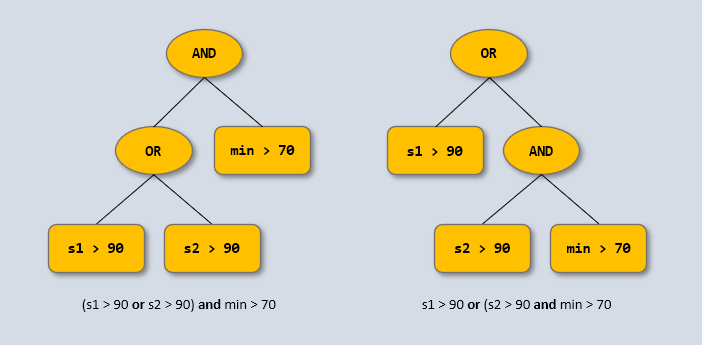
It is important to note that && takes precedence over ||. To see why one must be aware of this
fact, suppose s1 and s2 are exam scores and min is the minimum of those scores, and you want
to express the following condition for a passing grade: at least one of the scores is greater 90 and
the minimum is greater than 70. Is the following code correct?
s1 > 90 || s2 > 90 && min > 70
What happens if s1 is 95 and s2 is 65? According to the rule, this is a failing condition
since the minimum is not greater than 70. However, the expression evaluates to true since the
logical AND operation is performed first. The following code is logically equivalent but includes
parentheses to draw attention to the order of operations.
// The parentheses are not needed since && has precedence over ||,
// but they are included here for emphasis.
s1 > 90 || (s2 > 90 && min > 70)
For a correct expression of the grading rule, parentheses are needed to override the order of operations:
(s1 > 90 || s2 > 90) && min > 70
The way in which the meaning of the expression depends on the order of operations is vividly illustrated by the decision trees in Figure 5.5.2.
Figure 5.5.2: Decision Trees
5.5.3 Negation
Suppose variables futureDate and today refer to instances of the java.time.LocalDate class.
The isAfter method can be used to determine the temporal order of two dates. The following
code fragment shows two ways to check if futureDate is not actually in the future.
// Are futureDate and today improperly ordered?
if (futureDate.isAfter(today) == false) {
   // do something
}
// Are futureDate and today improperly ordered?
if (futureDate.isAfter(today) != true) {
   // do something
}
While these two expressions are syntactically and semantically correct, they could be simplified using the negation operator (also called the not operator):
// Is futreDate not in the future?
if (!futureDate.isAfter(today)) {
    // do something
}
The negation operator, written ! and read aloud as not, is one of Java’s unary operators. It
inverts the value of a Boolean expression. If isAfter returns true in the preceding code
fragment, the negation operator inverts it so that the entire expression evaluates to false.
Similarly, if the method returns false, the expression evaluates to true. The translation of
this logic into English would read:
If it is not true that the future date is after today, do something.
Listing 5.5.3 constructs a future LocalDate based on user input. It also calls the
LocalDate.now method to obtain the current date as determined by the system clock. Next, the
program calls isAfter and inverts the result with the negation operator to determine whether the
input date is not in the future. If so, the program displays an error message and terminates by
returning from the main method. On the other hand, if the input is valid, the program outputs the
number of days remaining until the future date.
Listing 5.5.3 - FutureDate.java
package chap05.sect5;

import java.time.LocalDate;
import java.time.format.DateTimeFormatter;
import java.time.temporal.ChronoUnit;
import java.util.Scanner;

/**
 * Prompts the user for a future date and outputs the number of intervening days.
 *
 * @author Drue Coles
 */
public class FutureDate {

   public static void main(String[] args) {
      System.out.print("Enter a future date (MM DD YYYY): ");
      Scanner in = new Scanner(System.in);
      int month = in.nextInt();
      int day = in.nextInt();
      int year = in.nextInt();

      LocalDate futureDate = LocalDate.of(year, month, day);
      LocalDate today = LocalDate.now();

      if (!futureDate.isAfter(today)) {
         System.out.println("That is not a future date. Goodbye.");
         return;
      }

      long daysUntil = ChronoUnit.DAYS.between(today, futureDate);
      DateTimeFormatter f = DateTimeFormatter.ofPattern("EEEE, MMMM dd, yyyy");
      System.out.printf("%,d days until %s. %n", daysUntil, f.format(futureDate));
   }
}
Output 5.5.3a
Enter a future date (MM DD YYYY): 12 25 2020
That is not a future date. Goodbye.
Output 5.5.3b
Enter a future date (MM DD YYYY): 10 17 2063
13,635 days until Wednesday, October 17, 2063.
5.5.4 Short-Circuit Evaluation
You have decided that if it is not raining and the temperature is at least 50 degrees when you wake
up in the morning, you will go for a run before breakfast. You wake up and see that it is raining.
Do you need to check the temperature? No, since it is raining, it is already clear that your
condition for running is not satisfied. This is an example of short-circuit evaluation. In
coding terms, if two Boolean expressions are combined by the logical AND operator and the first
expression is false, there is no point in evaluating the second since the entire expression is
guaranteed to be false.
The following code illustrates a situation in which short-circuit evaluation can be advantageous.
The if block will be executed if k is a prime number greater than 1000. The task of checking
primality is delegated to a helper method isPrime. But if k is less than or equal to 1000, the
pointless call to isPrime is avoided, eliminating the overhead of the method execution. If the
order of the operands were swapped, the code would still work correctly but the performance
advantage would be lost.
if (k > 1000 && isPrime(k)) {
    // do something
}
Another common use of short-circuit evaluation is shown below:
if (y != 0 && x % y == 0) {
    // do something
}
Here the if block will be executed if x is a multiple of y. But we only want to perform the
remainder operation if y is nonzero, since integer division by zero will cause an exception to be
thrown. Short-circuiting prevents the exception: if y is zero then the first expression is
false, in which case the second expression will not be evaluated.
Short-circuit evaluation works with logical OR too. Given an expression of the form E1 || E2,
the subexpression E1 is evaluated first, and if it is true then the entire expression is true
regardless of E2, in which case the latter is not evaluated.